
HUGO FERREIRA
Game Designer | Level Designer | 3D Artist
Designing immersive gameplay experiences and detailed 3D worlds.
STREET OF SHADOWS
-
Role: Level Designer / 3D Modeller
-
Tools: Unity, Blender, etc.
-
Duration: 4 months
-
Team size: just me

Street of Shadows is a first-person shooter created as part of my college game design project.
The level focuses on introducing movement, shooting mechanics, and player progression through guided gameplay.
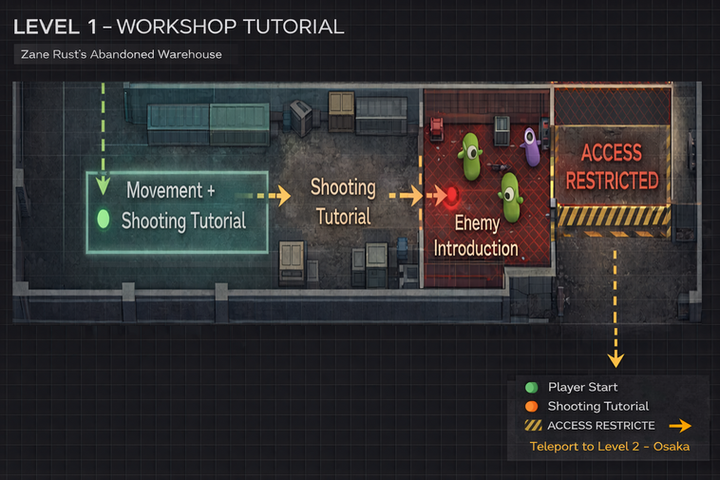
LEVEL 1 WORKSHOP TUTORIAL
DESIGN INTENT
Level 1 introduces the core gameplay systems within a controlled warehouse environment.
The space is intentionally linear to ensure the player learns essential mechanics before entering a larger combat space.
The layout integrates movement validation, shooting interaction, and first enemy engagement into a structured progression system. Advancement is locked behind mechanic completion to prevent players from bypassing foundational gameplay elements.
The objective of this level is mechanical clarity and structured onboarding.


PLAYER FLOW
Movement and Shooting Tutorial Zone
The player spawns directly inside the tutorial validation area.
Directional input is required to activate progression.
The shooting mechanic is introduced immediately within the same controlled space.
The player must fire their weapon before advancing.
Combat Validation
The first enemy encounter occurs inside the Shooting Tutorial zone.
The player must:
-
Engage the enemy
-
Successfully eliminate the target
-
Demonstrate basic combat understanding
Progression remains locked until the enemy is defeated.
This ensures active learning through interaction rather than passive instruction.
Teleport Gate Level Transition
At the end of the workshop, the “ACCESS RESTRICTED” gate acts as a progression validator.
Once all tutorial conditions are met:
-
The gate unlocks.
-
Teleport activation becomes available.
-
The player transitions to Level 2 Osaka City.
The teleport serves both narrative and mechanical progression, shifting from guided onboarding to open combat application.
SYSTEM DESIGN
Tutorial Validation System
-
Movement input detection required.
-
The shooting mechanic must be triggered.
-
Enemy elimination required.
-
The gate state changes from Locked to teleport active.
This structured gating system guarantees player readiness before escalation in difficulty.


Transition to level 2 OSAKA CITY
Level 1 concludes with a teleport transition into Osaka city.
The design contrast is intentional:
Level 1 — Controlled, instructional environment
Level 2 — Expanded urban combat space
This progression reinforces pacing, mechanical confidence, and environmental scale growth.


STREET OF SHADOWS
LEVEL 2 OSAKA CITY

Overview
Level 2 transitions the player from the controlled Workshop tutorial into an active urban combat environment.
The level reinforces core mechanics introduced in Level 1 while increasing spatial scale, enemy density, and environmental complexity.
Primary focus: mechanical application under pressure.
Design Goals
-
Reinforce movement and shooting systems
-
Increase encounter frequency
-
Introduce vertical combat spaces
-
Encourage positional awareness
-
Escalate pacing without tutorial gating
Layout Structure (Linear Urban Flow)
The level follows a straight-line progression across interconnected city blocks.
Entry Sector
Light re-engagement combat to reestablish player rhythm.
Mid-City Combat Zone
Open street encounters with multiple sightlines and flanking angles.
Vertical Engagement Block
Rooftop and elevated combat areas introduce height-based positioning.
Final Push
Higher enemy concentration leading to teleport exit.


_edited.jpg)
COMBAT DESIGN
Encounters are structured to test:
-
Target prioritization
-
Spatial control
-
Movement under crossfire
-
Risk assessment when retrieving health
Enemy placement creates forward pressure while maintaining readable combat flow.


Risk & Resource Placement
Health pickups are positioned off the primary path to encourage tactical risk-taking.
The player must choose between maintaining safe positioning or breaking formation for recovery.
Progression Function
Level 2 confirms player readiness for expanded combat spaces.
It marks the shift from instructional design (Level 1) to applied combat scenarios within a broader urban environment.

KEY TAKEAWAYS
-
I designed Level 1 to introduce core mechanics in a controlled environment where the player must actively perform movement and shooting before progressing.
-
I structured the tutorial so progression is earned through execution, not passive instruction.
-
I used the “Access Restricted” gate as both a mechanical validation point and a clear transition into a more open combat space.
-
In Level 2, I expanded the scale and increased pressure while keeping the layout readable and linear.
-
I placed enemies to guide forward momentum while avoiding overwhelming the player.
-
I positioned health resources slightly off-path to encourage risk-based decisions during combat.
-
I focused on making progression feel intentional — moving from structured onboarding to applied combat in an urban environment.


